
Valparaiso Previous Resident Sources
No single roll identifies every person who occupied a Valparaiso address. Start with the current parcel, then move back through deeds, transfer books, city directories, census schedules, maps, and death records. Each source answers a different question. A deed names owners, while a directory may name a renter or boarder. A map dates a building, but does not name its household.
| Source | Years It Covers | Where Held | What It Shows |
|---|---|---|---|
| Recorder deed index | Early 1978 onward online | Porter County Recorder | Owners, transfers, legal descriptions, and recording data |
| Older deed books | Before the online cutoff | Recorder ledger and microfilm | Earlier links in the chain of title |
| City and criss-cross directories | Selected years, 1885 to 2015 | Genealogy Center and State Library | Occupants, addresses, work, and household clues |
| Federal census | Public releases through 1950 | Library and archives databases | Households, relationships, ages, and occupations |
| Sanborn maps | Selected runs, 1886 to 1957 | Library collections | Building footprint, use, and old lot context |
| Death and obituary indexes | Varies by collection | Porter County local indexes | Dates, relatives, residence clues, and burial leads |
Keep evidence in its proper lane. Ownership does not always mean occupancy, and a mailing address may differ from the property address. One directory entry is a dated snapshot, not proof of an uninterrupted stay. Strong previous-residents research combines sources and records every gap.
Start With Valparaiso Parcel Data
Enter the present street address in the Porter County XSoft property search. Save the parcel number, situs address, owner of record, mailing address if shown, legal description, sales history, and any linked property card. Situs means the physical location of the parcel. It is not always where the tax bill goes.
Compare that parcel in the county tax list and GIS. Lots may have been split, combined, or renumbered, so the legal description is often more stable than a street number. Current assessor data is updated monthly, while annual cards follow a separate cycle. Treat the owner field as a title clue, not proof of who lives there.
The tax list adds district, tax year, owner, parcel, and property-address context. Its results are marked “Not for Official Use,” so cite the Assessor or Recorder when a formal ownership point matters. The GIS parcel service refreshes daily and can show roads, buildings, municipal lines, and lot geometry. If a parcel has no data or several lots share one number, save a map view and ask county staff to explain the current configuration.
Trace Porter County Owners Backward
The Porter County Recorder indexes instruments by party name and legal description, not as a dependable street-address directory. Start with the current owner from XSoft. Search that owner as grantee, the party receiving title, and locate the purchase deed. Record the seller, then search that seller as a prior grantee. Repeat one transfer at a time.
- Save the present owner, parcel number, legal description, and recent transfer date.
- Use Direct Search with the owner as grantee. Narrow by date and document type.
- Capture the grantor, grantee, recording date, instrument number or book and page, and legal description.
- Search the grantor as an earlier grantee. Confirm the same land before accepting the match.
- At the online cutoff, take the last book/page and legal description to the public terminal, ledger, or microfilm.
- Grantor
- The party transferring an interest in land.
- Grantee
- The party receiving that recorded interest.
- Chain of title
- The linked sequence of transfers for the same property.
- Legal description
- The lot, subdivision, section, township, range, or metes-and-bounds wording that identifies land.
Direct Search is free, has no images, can lag by seven days, and reaches early 1978. An older county guide places online images around August 1980, a separate cutoff. Tapestry currently costs $8.75 per index and image search. Laredo is subscription access. Recorder staff can route a caller but will not conduct a free historical search by phone.
For an office visit, the Recorder is at 155 Indiana Avenue, Suite 210, and lists weekday hours from 8:30 a.m. to 4:30 p.m. Documents are not accepted after 4 p.m., and land transfers moving through Auditor, Assessor, and Recorder must arrive by 3 p.m. Those filing deadlines do not limit ordinary terminal research, but they can make the counter busier late in the day. Bring a written list of names, dates, document types, and book references.
Valparaiso Records Before 1978
The free index cutoff is not the start of Porter County records. When the digital chain ends, use the Recorder's books and the Auditor's scanned tract, plat, transfer, and hanging-section files. The Historical Property Records project grew from 2021 ARPA funding and can bridge an old legal description to an earlier owner.
Transfer folders can be searched by township and owner surname. Tract and plat files use section, township, and range. A search limited to today's street address can miss the same land under an older parcel form. Mail-copy requests need a recording number or book and page. The older Recorder guide lists copies at $1 per page.
The Indiana State Library property research guide shows how deeds, maps, tax material, and local sources fit together.
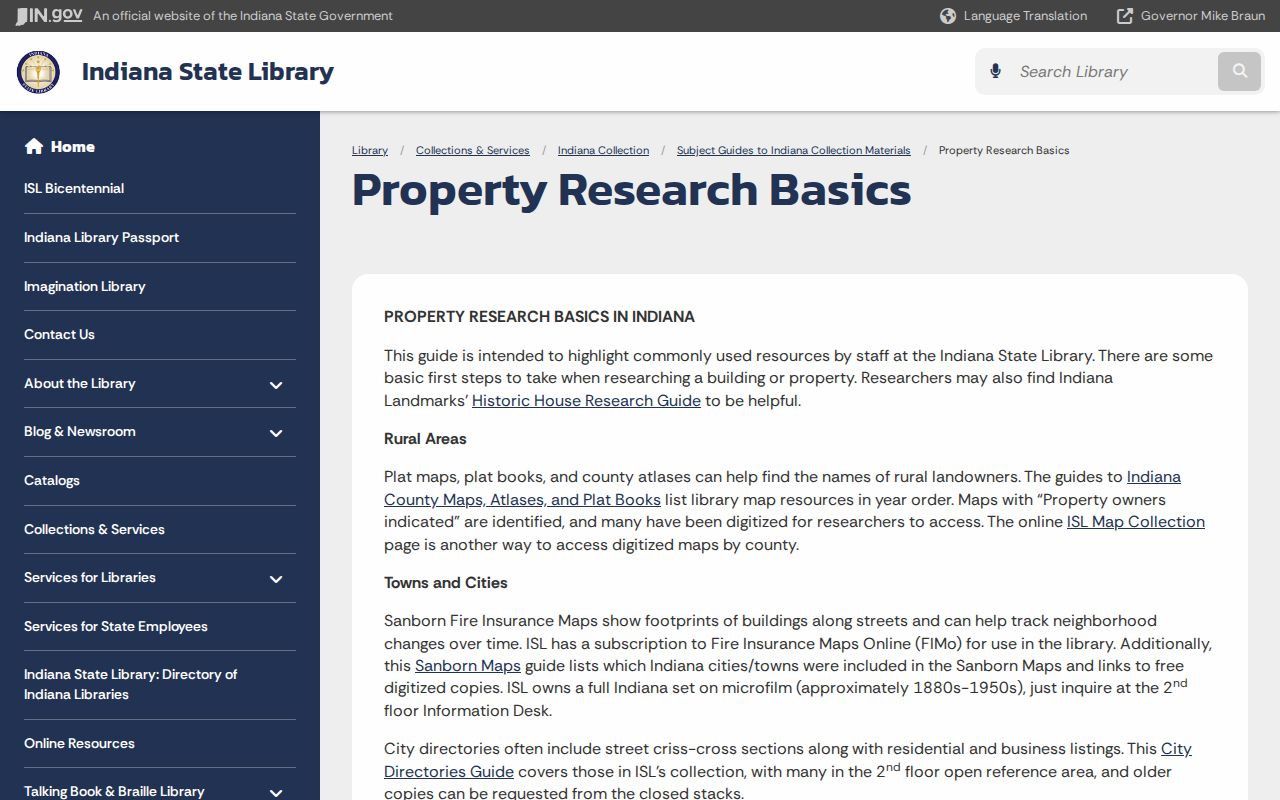
The guide reinforces why a Valparaiso address history rests on linked records rather than one surname result.
The 1937 WPA inventory offers another fallback. It is not a name index. Instead, it names record series once kept by county offices. A useful request quotes the record-group title, gives the old legal description, and asks whether the book survives at the office, Clerk Archives, State Archives, or another custodian. This is more precise than asking staff to search every old volume for an address.
Old Valparaiso Street Numbers
Valparaiso directories from 1893 and 1902 expose a change in street numbering. A literal backward search can jump to the wrong building or stop too soon. Preserve the old address as printed, then note cross streets, nearby businesses, resident names, and the legal parcel description.
Sanborn fire-insurance maps supply building outlines, street names, lot context, materials, and use. They help test whether two numbers point to the same structure. They do not identify a resident. Match the map with directories and deeds before claiming continuity. This local quirk is one reason past residents can seem to vanish between volumes.
Ask the Larry J. Clark Genealogy Center for street or reverse pages around the target year. Search names and addresses. Initials, spouse entries, boarding marks, businesses, and OCR errors can conceal a sound match.
The Genealogy Center occupies the second floor of the Valparaiso Branch at 103 Jefferson Street. Its specialist room opens Monday through Thursday and Saturday, but is closed Friday and Sunday. Call 219-462-0524 before a long trip. Holdings include directories, yearbooks, microfilm, indexes, newspapers, and library databases. Ask whether a needed year is on site, online, on microfilm, or available only through a reference request.
Pair Valparaiso Directories and Census
Printed directories fill years between federal censuses. Begin with the newest useful Polk volume, then step backward through selected runs from 2015, 2012, 2000, and the late twentieth century. Earlier Valparaiso runs include 1885 to 1886, 1893, and Bumstead editions from 1902, 1905, 1907, and 1911. Collection details belong to the Valparaiso city directory page.
- Copy the address entry and names exactly, including initials, spouse notes, work, and residence marks.
- Check the next earlier and later volume to bracket the household's arrival or departure.
- Match that window to a public census, using street, household members, age, and work as checks.
- Use newspapers, probate, deeds, and death records to explain changes between snapshots.
An enumeration district is the area assigned to one census taker. Its boundaries and household order can help after a renumbering, but nearby census entries are route clues rather than proof of an unchanged address.
Directory abbreviations require care. A residence marker can distinguish home from a work address, while a boarding notation may place a person at the property without making that person the householder. Widows may be indexed under a spouse's name, and a business can appear at the same number as a residence. Preserve punctuation and initials because scanned text may merge short names, apostrophes, and corner descriptions.
Valparaiso Death Trail Endpoints
When an owner dies, an obituary, death index, probate file, cemetery record, or successor deed may explain the next transfer. Search the Porter County death index with name variants and an approximate date.
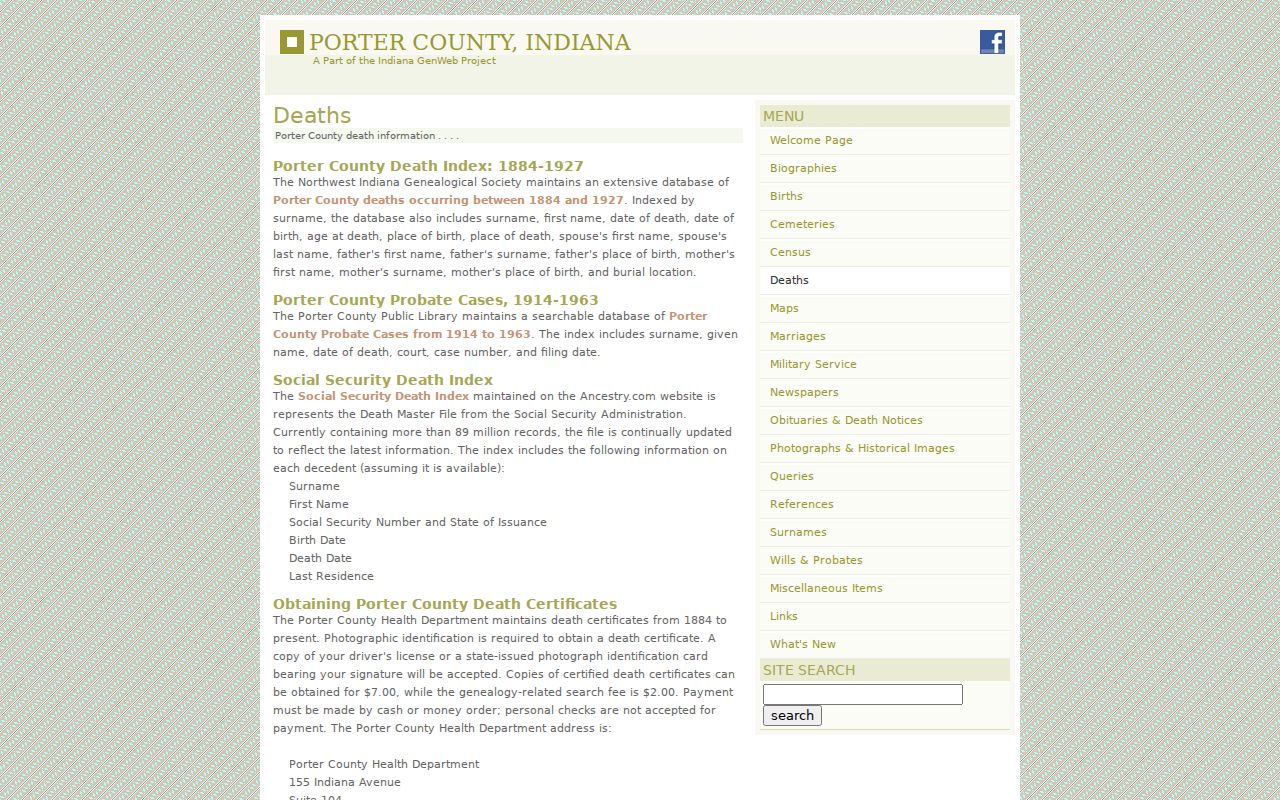
The date lead narrows newspaper and court searches, but does not prove the person's last address.
The Porter County obituary index may point to a notice with relatives, former residences, and burial details.
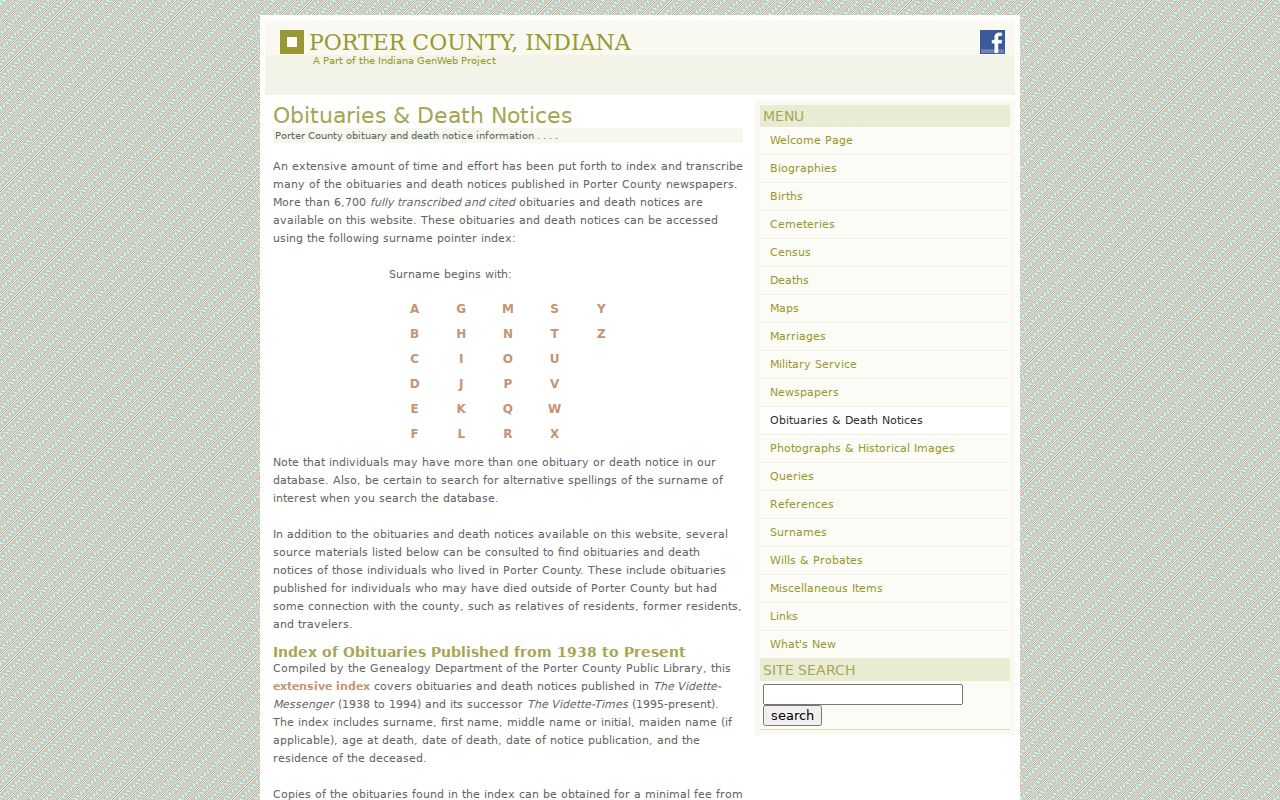
Use the notice as a lead, then confirm any transfer with the Recorder and estate proceeding with the Clerk.
For an estate question, search the court party index by the deceased person's name and ask the Porter County Clerk for the public probate file, will, inventory, or final accounting. The Clerk remains the custodian even when an index result appears online. Marriage, death, cemetery, and newspaper sources can distinguish two people with the same name. Never assume that the first obituary hit belongs to the parcel owner.
Valparaiso History Beyond Portals
PoCo Muse holds photographs, artifacts, exhibits, and local knowledge, though no public personal-name database was found. Send a focused inquiry with the street, person, era, and sources already checked. The historical society began in 1916 and moved through four homes before the museum's current site opened at 20 Indiana Avenue in 2022.
The Porter County Museum holdings page introduces the collection and inquiry route.
Ask whether a result is an original, index, finding aid, scan, or staff transcription. The form of the source controls what it proves.
The 1937 WPA county archives inventory identifies older record groups that modern portals may omit. Use its titles in a focused office or archive request. No official source documented a courthouse fire or destroyed decade, so do not explain a missing result as record loss without proof.
Test Valparaiso Previous Resident Claims
Build a dated evidence log, not a bare list. For each possible past resident, record the source, date, address as printed, role, and confidence. A deed proves a recorded interest. A directory supports occupancy near publication. A census supports a household on enumeration day. An obituary may name a former home, while probate can show heirs and estate work.
City permit and code records can add project dates, but no public searchable Valparaiso permit-result database was located. Request existing material by address, parcel, type, and date range. The City Archive can also surface ordinances, minutes, site reviews, annexations, and rights-of-way tied to a street.
Finish with a simple chronology. Put every deed, directory, census, map, permit, obituary, and probate event on its actual date. Mark conflicts instead of choosing the most convenient answer. A missing year means “not found in that source,” not “nobody lived there.” This method produces a defensible account of who lived here before while keeping owners, occupants, relatives, and neighbors in distinct roles.
Previous residents may appear under several forms of a name. Test initials, a spouse's name, a widow notation, and common spelling variants. Compare ages, occupations, relatives, and street context before merging two entries. If the deed owner differs from the directory householder, retain both facts. That difference may reflect a renter, family arrangement, estate, trust, business, or delayed publication, but the records must supply the explanation.
A useful final inventory lists each source that was checked and each access channel still open. Online options include XSoft, GIS, Direct Search, local PDF indexes, and digitized directories. In-person options include Recorder terminals, older ledger or microfilm, the Genealogy Center, and office files. Written options include a precise mail copy order, Clerk Archives request, or public-records request. Phone staff can identify the right counter, though Recorder staff do not search the title chain for callers.
Previous residents should be reported with dates: “listed at the address in the 1985 directory” is sounder than “lived there in the 1980s.” The same rule applies to title. Say “named as grantee on the recorded deed” instead of claiming uninterrupted ownership. These phrases preserve what the source actually shows and make later corrections easy when another volume or instrument appears.
The best Valparaiso previous residents trail ends with citations another researcher can repeat. Keep the portal URL, access date, document number or book/page, directory year and page, census location, and archive call number. Save image access status separately from index data. With that audit trail, past residents become a researched sequence rather than a copied list of uncertain names.
Property and household dates rarely line up neatly. A deed may be signed on one day and recorded later. A directory may reflect canvassing done months before publication. Census information belongs to one enumeration day, and an obituary may summarize several former homes without dates. Put each event on the date the source supports, then use a range when arrival or departure falls between two records. Do not turn the gap into an exact move date.
Corrections should return to the office that holds the source. Ask the Assessor about a parcel-card field, the Recorder about an instrument or copy, the Clerk about a probate file, and the library about a directory scan. An index transcription can be wrong even when the original record is sound. Inspect the image or certified copy when spelling, identity, or land description affects the conclusion. This final check keeps a previous residents account tied to Porter County evidence.
Lawful use. Research previous residents for house history, family history, heirs, or personal curiosity. Never use a record trail to watch, harass, intimidate, or harm a living person.